

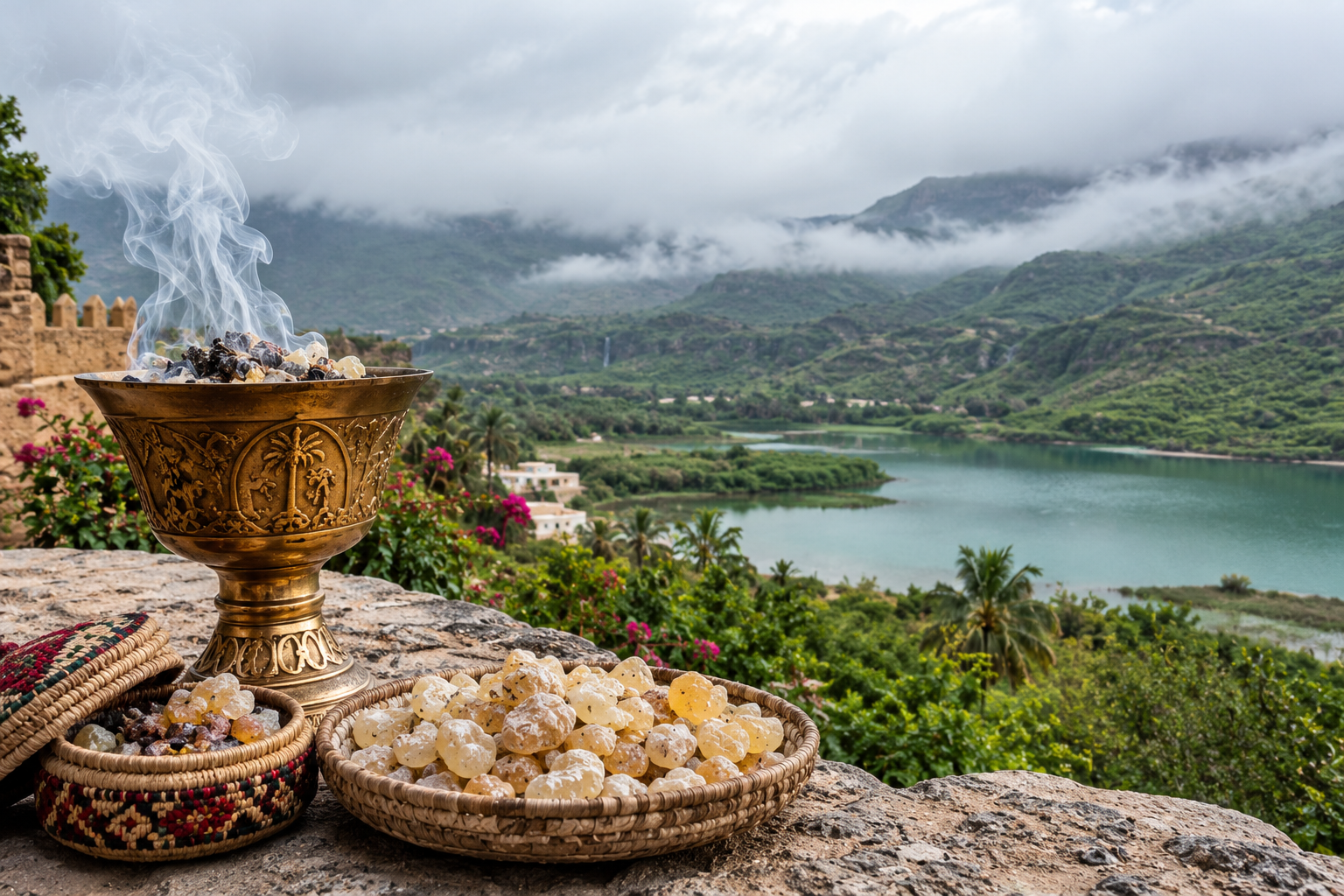
September 2025 gifted me one of the most unexpected sensory experiences of my life — the monsoon-like Khareef season in Salalah, nestled in the lush region of Dhofar. When most people imagine Oman, they think of arid deserts and dry heat. But Khareef rewrites that narrative entirely.
The mountains, once rugged and distant, had softened into a velvety green embrace, as if nature had draped them in fresh silk. Clouds slowly descended from the sky, not just hovering above but slipping gently down to earth, wrapping everything in a soft, misty veil. One could walk through them, feel them — cool droplets settling on the skin, dampening the hair, blurring the line between sky and land. And in that moment, even the air carried a scent — pure, earthy, and alive — like the fragrance of rain, water, and green life all woven into one.
The lake deepened into a richer shade of green, alive and breathing, its waters teeming with vibrant aquatic life that seemed to dance beneath the surface. The air itself felt different — thick with freshness, almost drinkable.
A Landscape Defined by Aroma
From the moment I landed at Salalah Airport, the journey itself felt like an introduction to scent rather than scenery.
Even inside the terminal, the air carried a soft, resinous warmth of olibanum — subtle yet unmistakable, as if the space had gently hugged me with incense. Stepping outside, everywhere I went, I could sense the warm, resinous presence of olibanum, as if it had become a part of the atmosphere itself.
It wasn’t just in its raw, natural form; the markets displayed it in beautiful variations — blended with colours, infused with different fragrances, transformed into red, green, and golden hues.
Each variation told its own story, offering a new dimension of scent — sometimes sweet, sometimes smoky, sometimes fresh. It felt as though the entire place was breathing in rhythm with this ancient aroma, wrapping every passerby in a subtle, fragrant embrace.
In local markets, in the streets, even in the air drifting through the hills, incense wasn’t just a product — it was part of the environment. Alongside this were subtle gourmand and fruity notes: the creamy sweetness of coconut and the soft, ripe greenness of banana trees thriving in the Khareef moisture.
This natural olfactory blend felt like a living perfume — earthy, milky, green, and resinous all at once.
The Chemistry of Olibanum (Frankincense)
Olibanum comes from the resin of trees in the genus Boswellia, most notably Boswellia sacra, which grows in places like Oman, Yemen, and parts of Somalia. These trees thrive in harsh, dry, rocky environments — producing one of the most spiritual and rich aromas in perfumery.
When the bark is cut, it exudes a milky sap that hardens into aromatic resin tears.
Olfactory Profile
The scent of olibanum can be broken down into layers:
Top notes: Sparkling citrus, slightly peppery
Heart notes: Resinous, incense-like, meditative
Base notes: Warm, balsamic, subtly woody
During combustion, as seen in the incense burner in your photo, thermal degradation slightly alters the profile — enhancing smoky, leathery, and almost mystical facets.
Khareef Meets Chemistry: A Natural Accord
What made Oman unique for me was how nature itself creates accords that perfumers try to replicate artificially.
Coconut nuance: Likely from lactonic compounds in humid vegetation and local foods.
Banana notes: Reminiscent of isoamyl acetate-like fruity impressions in the air.
Wet earth & greenery: Geosmin and plant volatiles after rain.
Frankincense smoke: A complex resinous overlay tying everything together.
Incense Culture: More Than Just Fragrance
In Oman, incense is not occasional — it is ritualistic and continuous. The traditional burner diffuses smoke that lingers on clothes, skin, and surroundings.
This creates something perfumers strive for: sillage that becomes identity.
Unlike alcohol-based perfumes, incense works through:
- Slow volatilization
- Thermal transformation
- Surface absorption (fabric, wood, skin)
This makes the fragrance feel more alive and evolving.
A Perfumer’s Reflection
As someone deeply connected to fragrance, Oman felt like walking inside a raw formula — where every note exists in its purest form.
Khareef is not just a season; it is an olfactory phenomenon.
It taught me that:
- Fragrance is not always bottled — sometimes it is environmental.
- Chemistry and culture are deeply intertwined.
- Natural materials like olibanum are not just ingredients, but experiences.
A formula no lab can fully recreate — only nature can.
Somewhere between the breathing mountains and the rain-softened hush of Khareef, Oman ceased to be a place I was passing through and became a presence I could not leave behind.
It arrived quietly — first as a whisper in the air at the airport, then as a soft, resinous veil that followed me through streets, markets, and mist.
The scent of olibanum did not simply surround me; it unfolded, layer by layer, like a living composition — warm, luminous, almost sacred — until it dissolved into something far more intimate than memory.
It settled into me the way a fine note anchors itself in a perfume’s heart — steady, enduring, impossible to erase. Even now, it lingers in the silence between breaths, in the spaces where words fall short, leaving behind a trace that feels both ancient and deeply personal.
Oman, in all its incense-laced beauty, did not ask to be remembered — it chose to remain.
And perhaps this is only the beginning of understanding it. In the next part of my journey, I will follow this invisible trail deeper into the very chemistry and soul of its olibanum, where scent transforms into story.
Archana Shandilya
Fragrance Expert, Dubai









Add Comment