
Read this post in
 Arabic
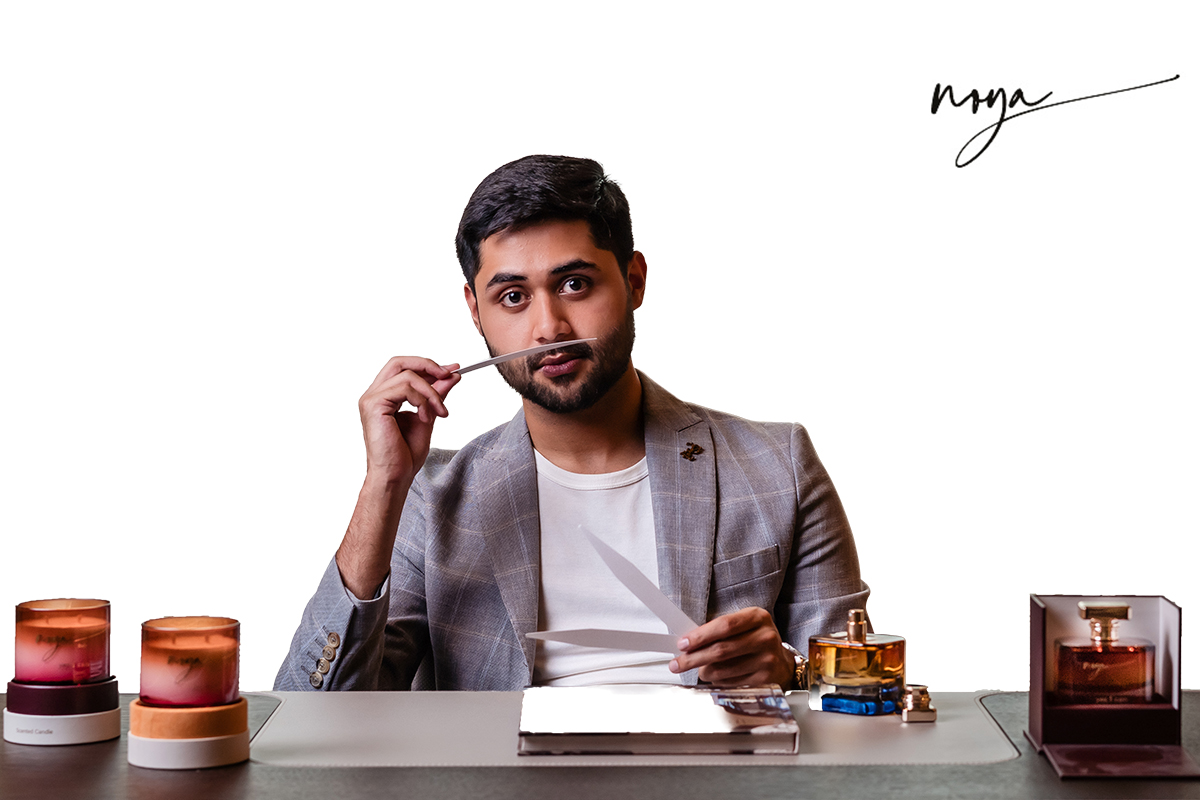
“A Scent Should Pull You In, But Also Unfold Slowly.”
Talha Kalsekar, Creative Director – House of Noya | Rasasi 1979 | Azha, on redefining legacy through evolution
In this exclusive interview with ParfumPlus Magazine, Talha Kalsekar reflects on evolution, creative independence and the emotional narratives shaping House of Noya, offering a perspective that balances inherited legacy with a distinctly personal and contemporary voice.
 ParfumPlus: Born into a celebrated fragrance legacy, House of Noya feels distinctly independent. When did you realise evolution, not just continuity, was essential to honour it?
Talha Kalsekar: For me, the realisation came quite early, though not in the way people might expect. I didn’t initially want to follow my family’s path. When you grow up surrounded by it, there’s both respect and a need to step away, to understand who you are beyond what’s already defined. Studying in London shaped me deeply. It exposed me to different cultures and gave me a sense of individuality. It’s where I built my own perspective and identity.
Through that distance, I understood something important. If I were to return to fragrance, it couldn’t be about continuity alone. Repeating what’s been done doesn’t honour a legacy, it keeps it still. Evolution became essential when I realised the only honest way to respect where I come from is to add to it through my own lens.
Every experience I’ve lived has become a source of inspiration. That’s what defines House of Noya. So for me, evolution wasn’t a decision; it was a necessity. It’s the only way legacy stays alive, by growing into something personal while still carrying its roots.
PP: The word “niche” is often diluted in perfumery today. When you position House of Noya as truly niche, what are you resisting and what will you never compromise?
TK: Today, “niche” has become very comfortable. It’s often used to describe distribution or pricing, when it should reflect a mindset. For me, being truly niche means resisting standardisation. It means not creating fragrances to fit trends or commercial formulas.
With House of Noya, I resist the pressure to make something instantly likeable at the expense of depth. Not every fragrance needs to be understood in the first minute. I believe in compositions that evolve and stay with you.
What I will never compromise on is intention. Every scent has to come from a real place. I’m also protective of the creative process, from ingredients to collaborations. It has to feel honest.
Exclusivity isn’t about being inaccessible; it’s about being precise. So when I say “niche,” I’m talking about freedom. The freedom to create without dilution, and the discipline to stay true to that.
PP: Operating across creation and commerce, does this proximity sharpen your instincts or demand constant negotiation between creativity and market reality?
TK: For me, it’s a balance, not a conflict. Operating closely between creation and commerce has sharpened my instincts. You develop sensitivity not just to the product, but to how people experience it. I don’t see creativity and market reality as opposing forces. They keep each other in check. The creative side pushes boundaries, while the commercial side ensures clarity.
That said, I’m careful not to let the market dictate direction. The moment you create only to sell, you lose the essence. So proximity doesn’t dilute the vision; it refines it. It’s less about compromise and more about discipline, knowing when to listen and when to protect the idea.
PP: House of Noya leans into emotional storytelling. In a narrative-saturated industry, how do you ensure your stories feel lived, not constructed?
TK: With House of Noya, I’ve never approached storytelling as something built around a product. The story exists first, and the fragrance translates it. What keeps it real is staying close to personal experience. The memories I draw from aren’t abstract; they’re specific, sometimes uncomfortable. That’s what gives them weight.
I also don’t try to over-explain. A lived experience isn’t linear. I’d rather leave space for interpretation. So I don’t chase the narrative. I let it come from something real, and I protect that. If it doesn’t feel honest, it doesn’t become a fragrance.
 PP: As a third-generation creative, you inherit both memory and expectation. Which parts of the Rasasi legacy do you consciously preserve and which did you need to unlearn?
TK: Inheriting that legacy comes with clarity and pressure. I preserve the discipline, understanding of raw materials and patience behind building a fragrance. There’s also an intuition that comes from generations of working with scent.
At the same time, I had to unlearn certain structures—the idea that fragrance must follow a specific format or appeal predictably. I stepped away from thinking commercially first and reconnected with what feels meaningful creatively. With House of Noya, I’m not replicating the legacy; I’m reinterpreting it. Preserve the foundation, remove the boundaries.
PP: Resilience is often romanticised in brand language. When did it become a necessity for you and how did that moment fundamentally reshape the direction of House of Noya?
TK: Resilience became necessary when things stopped aligning as I imagined. Building House of Noya, there were moments where the vision felt too personal and not always understood. That’s where resilience became real.
I had to decide whether to adjust the brand or stay committed to what I believed. That decision changed everything. It made me more precise and intentional.
Resilience reshaped the brand by stripping it to its core, focusing on story, honesty and emotional connection. It also taught me patience. It didn’t make the brand louder; it made it sharper and more grounded.
PP: Having studied in the UK and travelled extensively, especially through Italy, how have these contrasts shaped your view of what a modern fragrance house should represent?
TK: Those contrasts didn’t feel like inspiration at first, they felt like different parts of my life.
The UK gave me distance and structure. Italy was instinctive and emotional. Coming from the Middle East, where fragrance is deeply cultural, these experiences created a tension. I realised that tension didn’t need resolving, it’s where things made sense. That’s how I see House of Noya. Not fitting into one definition, but existing where all of that comes together. A modern fragrance house shouldn’t belong to one place. It should reflect real, even contradictory experiences.
PP: Niche perfumery balances artistry and accessibility. Should a fragrance challenge its wearer or seduce and is that tension where the magic lies?
TK: It’s not about choosing one. If it’s too comfortable, you forget it. If it’s too challenging, you disconnect. The balance is where it becomes interesting.
A scent should pull you in, but also unfold slowly. That’s where the magic is. The most memorable fragrances evolve with you. They don’t reveal everything at once, they stay and become personal over time.
 PP: As House of Noya expands globally, what perception of Middle Eastern perfumery would you most like to challenge?
TK: One misconception is that it’s one-dimensional. There’s an idea that it’s only about intensity, but what people miss is the depth and diversity.
With House of Noya, I want to show it’s not just a style, it’s a language. It carries history and emotion, but it can also be subtle and modern.
It’s not fixed; it’s evolving. For me, it’s about showing you can stay rooted in heritage while creating something global and personal.
PP: What message would you like to share with ParfumPlus readers?
TK: Fragrance is personal. Don’t approach it as something you need to understand immediately. Give it time and let it connect in its own way.
With House of Noya, every scent is meant to be experienced, not just worn.
So my message is: stay curious. Explore beyond what you know, and don’t be afraid of something different. That’s where you find fragrances that truly become yours.
Read this post in
Arabic